
MotherBear Marine / Origin
HydroEye began as a robotics problem.
Before HydroEye became a subsea sensing platform, it began with a simple question: how can researchers test underwater perception systems without deploying an entire robot?
01 — The Problem
Robotics experiments carried unnecessary risk.
Underwater robotics projects often depend on cameras, lighting, compute, and other sensing hardware integrated into larger robotic platforms.
Testing those sensing systems through the robot itself can make experimentation slower, more expensive, and more operationally complex than necessary.
02 — The Insight
Put the robot's sensing system in a diver's hands.
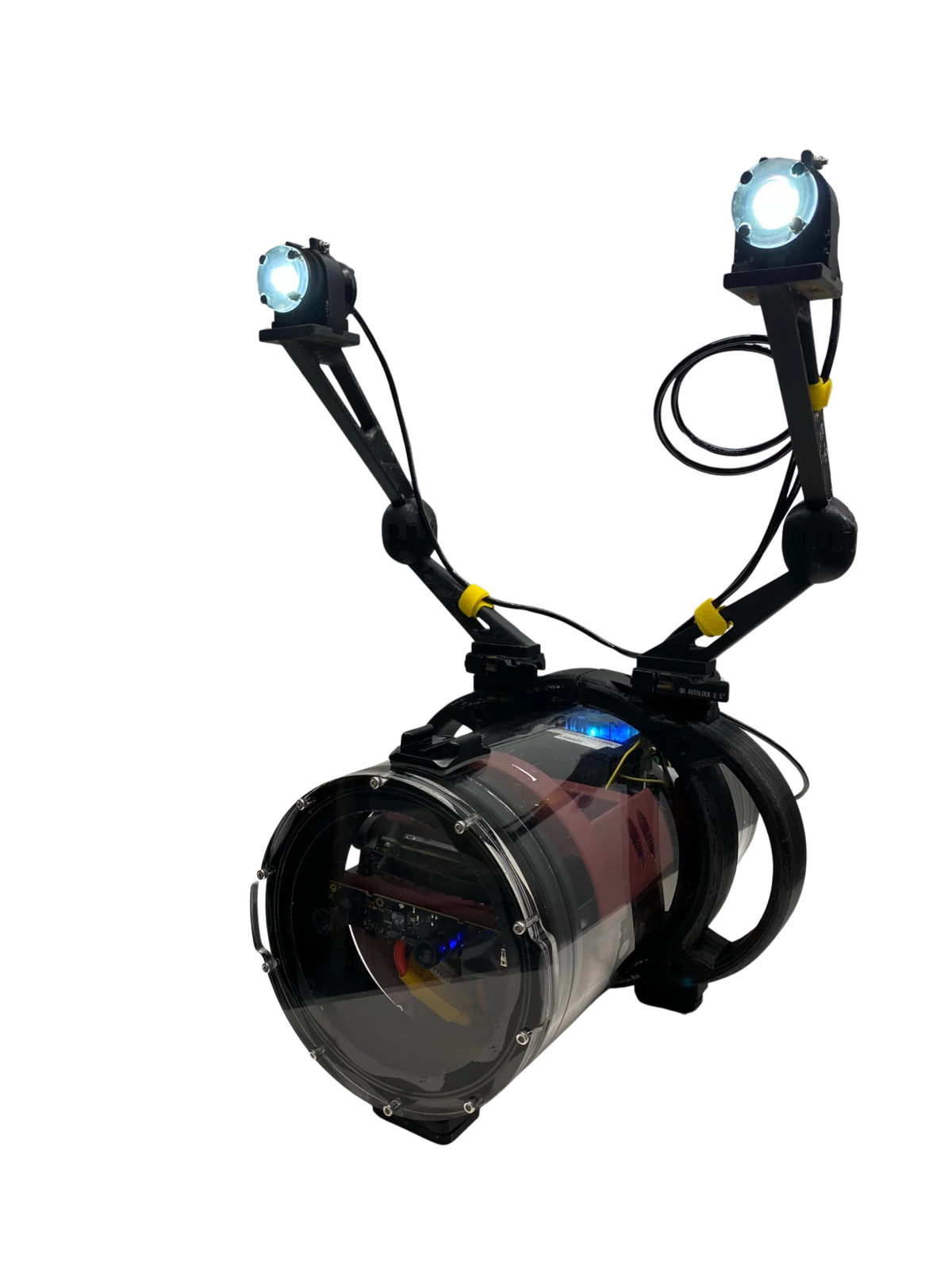
Junaed Sattar and Jungseok Hong recognized the need for a small, hand-held sensor system that could replicate the sensing capabilities normally carried by an underwater robot.
The concept allowed researchers to take perception hardware into the water directly, collect representative data, evaluate sensing configurations, and de-risk larger robotics projects before committing to a full robotic deployment.
What began as a way to simplify robotic experimentation also revealed something larger: the sensing platform itself could become a powerful tool for collecting structured underwater data.
03 — HydroEye
A research instrument became a data platform.
HydroEye evolved from that original idea into a diver-portable subsea sensing system designed for repeatable field data acquisition.
By separating sensing and data collection from the complexity of a full robotic platform, HydroEye created a pathway into larger, data-centric projects involving perception, machine learning, inspection, and underwater autonomy.
04 — Creators
The people behind HydroEye.
Jungseok Hong

Chelsey Edge

Rishi Mukherjee
05 — Research Origins
Interactive Robotics & Vision Laboratory
HydroEye was developed through research at the University of Minnesota's Interactive Robotics & Vision Laboratory.
The laboratory's work in underwater robotics, perception, and human-robot interaction provided the technical environment in which the HydroEye concept was conceived, developed, and tested.
MotherBear Marine carries that engineering lineage forward by translating field-tested sensing research into systems for commercial underwater data acquisition and perception.

Interactive Robotics & Vision Laboratory
University of Minnesota
Scan the QR code or visit the laboratory website to learn more about the research environment where HydroEye originated.
irvlab.cs.umn.edu06 — What Came Next
De-risk the robot. Keep the data.
HydroEye showed that a portable sensing platform could do more than support robotics research. Every deployment could also generate the underwater datasets needed for the next generation of perception systems.
That insight forms part of the foundation of MotherBear Marine: begin with robust field sensing, build structured underwater data, and use that data to enable increasingly capable perception and autonomous systems.